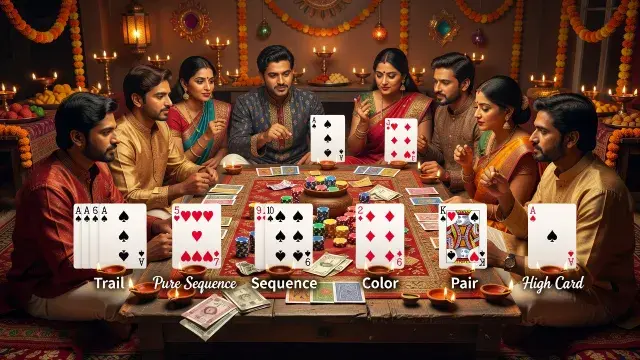
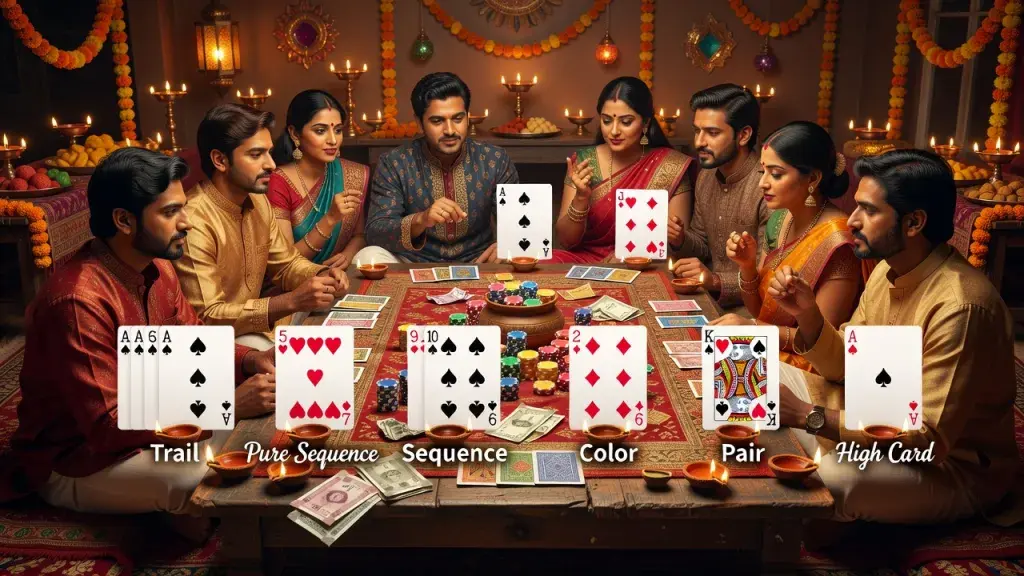
Three cards. One pot. A blind bet that doubles every time someone refuses to look at their hand. That single mechanic - the choice between playing blind or playing seen - separates Teen Patti from almost every other card game on the planet and explains why it has held cultural weight across South Asia for generations. It looks simple on the surface: three cards dealt, best hand wins. But the betting psychology underneath that simplicity is where the game actually lives.
Most newcomers learn the ranking of hands within minutes and assume they understand the game. They don't, not fully. The real skill sits in reading when to bet blind, when to fold a decent hand, and when a weak hand becomes the perfect bluffing tool. Before testing any of that at the table, it helps to review the full teen patti rules on a platform that lays out betting limits and table variants clearly, so there are no surprises once real chips are on the line. This article breaks the game into digestible parts - how the deal works, what beats what, which variations change the entire risk calculation, and how to build a betting approach that doesn't collapse the first time an opponent goes blind and raises aggressively.
By the end, you'll have a working framework, not just a list of rules. That distinction matters more than most guides admit.
What Is Teen Patti and Why It Remains So Popular
Teen Patti translates roughly to "three cards" in Hindi, and that name is the entire premise. It descends from the same family of games as three-card brag and poker's simpler ancestors, but it developed its own identity through the blind-betting mechanic and its social, high-tempo style of play. Rounds move fast. Pots build quickly. Decisions get made with incomplete information far more often than in most poker variants, which is exactly why it rewards nerve as much as arithmetic.
Origins and Cultural Context
The game emerged in South Asia as a home and festival pastime, particularly popular during Diwali gatherings, and it carried that social, gambling-adjacent identity into the modern era. Its structure - small ante, escalating blind bets, quick showdowns - made it ideal for group settings where speed and banter mattered as much as the cards themselves.
Why It Appeals to New Players
Unlike five-card poker, there's no flop, no turn, no river to memorize. Three cards, one round of escalating decisions, and a showdown. That low barrier to entry is precisely why so many people search for teen patti rules for beginners before their first real session - the game is easy to start but genuinely difficult to master once the betting patterns get sophisticated.
How to Play Teen Patti: Core Rules Explained
Understanding how to play teen patti starts with the deal. Each player receives three face-down cards from a standard 52-card deck, no jokers. Before any cards are dealt, every player contributes a fixed ante called the "boot" to the pot. Play then moves clockwise, and each player must decide, on their turn, whether to stay in as a "blind" player (not looking at their cards) or switch to "seen" status (looking at their cards, which typically doubles their minimum bet going forward).
The Deal and the Boot Amount
The boot is a mandatory minimum stake that seeds the pot before any strategic decisions occur. It's usually a small, fixed amount agreed upon before the session starts, and it stays consistent for the entire round of play. Without it, there would be no incentive to fold early, since there'd be nothing at stake yet.
Blind vs Seen Betting
This is the mechanical heart of the game. A blind player bets without knowledge of their hand, keeping their wager at the current table stake. A seen player looks at their cards and must bet at least double the current blind stake to stay in. This asymmetry creates constant tension - blind players carry less information but also project less predictable behavior, while seen players know their hand but pay a premium to act on that knowledge.
The Showdown and Winning the Pot
When only two players remain, one can request a "show," comparing hands directly. The better hand, according to standard rankings, takes the entire pot. If more than two players remain, a show can only occur between the last two active players in most rule sets, which keeps earlier folds from resolving prematurely.
Teen Patti Hand Rankings You Must Memorize
Every strategic decision in the game traces back to teen patti hand rankings. Get these wrong, and you'll misjudge the strength of your hand at the exact moment it matters most. The rankings run from strongest to weakest as follows:
- Trail or Set (three cards of the same rank) - the strongest possible hand, with three Aces at the top
- Pure Sequence (three consecutive cards of the same suit) - a straight flush in poker terms
- Sequence (three consecutive cards, mixed suits) - a regular straight
- Color (three cards of the same suit, not in sequence) - a flush
- Pair (two cards of matching rank plus one unrelated card)
- High Card (no matching rank, no sequence, no shared suit) - ranked by the highest card, then the second-highest
Why Trail Beats Everything
Three of a kind is statistically rare in a three-card format, which is why it sits above even a pure sequence. The probability of being dealt matching ranks across only three cards is low enough that the hand deserves top billing, and experienced players almost always commit heavily when they hold one.
Common Ranking Mistakes Beginners Make
New players frequently confuse a color (flush) with a sequence, assuming same-suit cards automatically outrank consecutive ones. They don't. A mixed-suit sequence beats a same-suit color every time, because the sequence itself is harder to assemble across suits than a same-suit combination is to assemble at random.
Teen Patti Variations and Rules Every Player Should Know
The base game is only the starting point. Regional and house-specific teen patti variations and rules change hand values, betting limits, or even the number of cards involved, and knowing which variant is on the table before you sit down is not optional - it's survival.
Muflis (Lowball Teen Patti)
In Muflis, the rankings invert. The lowest hand wins, which means a trail of low cards becomes the premium hand instead of the liability it would be in standard play. This variant punishes players who instinctively apply standard-game logic without adjusting.
AK47 and Wild Card Variants
Some tables designate specific cards - Aces, Kings, 4s, and 7s, for instance - as wild, capable of substituting for any card to complete a stronger hand. This dramatically increases the frequency of trails and pure sequences, which in turn changes optimal betting behavior, since strong hands become far more common.
Joker Teen Patti
A designated joker card (sometimes a randomly drawn card each round) acts as a universal wild card. This variant rewards aggressive betting on marginal hands more than the standard game does, because the odds of hidden strength go up for everyone at the table.
Best of Four and 999
Best of Four deals four cards instead of three, letting players choose their best three-card combination - a small change that meaningfully lowers variance. The 999 variant, popular in some regions, uses a points-based counting system rather than direct hand rankings, closer in spirit to rummy than classic poker-style comparison.
Teen Patti Betting Strategy for Long-Term Success
A sound teen patti betting strategy isn't about memorizing a single "correct" move - it's about adjusting behavior based on pot size, table temperament, and how many players remain active. The game rewards controlled aggression far more than either passivity or recklessness.
Bankroll Management Basics
Set a fixed session limit before playing and treat it as non-negotiable. Because blind bets escalate quickly, pots can balloon within a handful of rounds, and players without a predefined stop-loss point routinely lose far more than they intended.
When to Play Blind and When to Look
Staying blind keeps your bet lower and denies opponents information about your confidence level. It's a strong choice early in a hand, especially at tables with several players, since folding later costs less than committing seen-level stakes to a hand you haven't even evaluated. Switching to seen makes sense once the pot grows large enough that acting on real information outweighs the doubled stake.
Reading Opponents and Bluffing Effectively
Consistent bet sizing from a blind player often signals genuine confidence, while erratic raises frequently indicate a bluff attempt. Effective bluffing in Teen Patti depends on table image - a player who has shown down strong hands earlier can bluff more convincingly later, because opponents have already seen evidence of real strength.
Knowing When to Fold
Discipline separates long-term winners from short-term lucky streaks. If the pot escalates beyond a comfortable multiple of your boot amount and your hand ranks below a color, folding preserves capital for a round where the odds favor you more clearly.
Common Mistakes Beginners Make and How to Avoid Them
Most losses in early sessions don't come from bad luck - they come from predictable, avoidable decisions repeated under pressure.
Chasing Losses After a Bad Hand
Increasing bet size to recover a previous loss ignores the fact that each hand is statistically independent. The cards dealt in the next round carry no memory of the last one, and treating them as connected leads to steadily worse decisions.
Misjudging Hand Strength Under Pressure
Under time pressure, players sometimes overvalue a color or a low pair simply because it feels better than nothing. Reviewing teen patti hand rankings before sitting down, rather than trying to recall them mid-hand, prevents this kind of costly miscalculation.
Ignoring Table Variant Rules
Sitting down at a Muflis or wild-card table while applying standard-game instincts is one of the fastest ways to lose a session. Confirming the variant and its specific teen patti variations and rules before the first deal removes this risk entirely.
Frequently Asked Questions
Is Teen Patti purely a game of luck?
No. While the initial deal is random, the betting decisions that follow - when to go blind, when to look, when to fold - determine long-term results far more than any single hand's luck. Skilled players consistently outperform less disciplined ones over extended play.
What's the minimum number of players needed for a game?
Teen Patti typically requires at least three players to function properly, though it can be played with two in a pinch. Most social and competitive settings involve four to six players, since larger groups create more betting dynamics and bluffing opportunities.
Can a blind player see their cards mid-hand?
Yes. A blind player can choose to "see" their cards on any of their turns, but doing so typically doubles their required bet from that point forward. This trade-off between information and cost is central to the game's strategic tension.
What happens if two players have identical hand rankings?
Ties are broken by card rank within the same hand type - for example, two sequences are compared by their highest card. If every card matches exactly, which is extremely rare, the pot is typically split according to house rules.
Which variation is best for someone learning the game?
Standard Teen Patti, without wild cards or inverted rankings, is the best starting point. It teaches core hand rankings and betting rhythm without the added complexity that variants like Muflis or Joker Teen Patti introduce.
How large should the boot amount be relative to my bankroll?
A common practical guideline is keeping the boot small enough that twenty to thirty rounds wouldn't threaten your total session bankroll. This buffer accounts for the rapid escalation that blind betting can produce within just a few rounds.