A withdrawal request that takes ninety seconds to submit can take anywhere from ten minutes to five business days to actually land in your hands, depending entirely on the method you choose. That gap between "requested" and "received" trips up more people than any other part of managing money, whether it involves a paycheck, a betting account, an online wallet, or straightforward cash sitting in a bank vault. The mechanics differ wildly across cash counters, blockchain networks, banking rails, and digital wallets, and mixing them up costs time, money, or both.
This guide breaks down five distinct withdrawal paths and explains exactly what happens behind the scenes with each one. Some platforms bundle several options into a single dashboard, and understanding the fine print on fees, limits, and processing windows for how to withdraw in becomes the difference between a smooth payout and a frustrating wait. There's no universal "best" method - only the right one for your situation, your urgency, and your tolerance for fees.
By the end, you'll know precisely when cash makes sense, why bitcoin withdrawals behave nothing like bank transfers, and how ATMs fit into the picture despite feeling almost old-fashioned next to crypto wallets. Each method has its own rhythm, and knowing that rhythm in advance saves real frustration.
Understanding the Basics of Withdrawing Money
Before comparing specific methods, it helps to understand what actually happens during a withdrawal. Money rarely "moves" in a physical sense - it gets reassigned in ledgers, verified by intermediaries, and released according to rules set by banks, payment processors, or blockchain protocols. Every method discussed here follows this same underlying logic, just with different actors involved and different speeds.
What "Withdrawing" Actually Means
Withdrawing money means converting a balance held by a third party - a bank, an exchange, a digital wallet, or an online platform - into a form you can directly use: physical cash, a deposit in your personal account, or a transferable digital asset. The account holding your funds doesn't hand over cash directly in most cases; it authorizes a transfer, which then travels through one or more verification layers before reaching you.
Why Withdrawal Speed and Fees Vary So Much
Speed depends on how many intermediaries are involved and whether human review is required. A same-bank transfer might clear instantly because no external verification is needed. A cross-border wire, by contrast, might pass through several correspondent banks, each adding a processing window and a fee. Fees generally reflect risk and infrastructure cost - cash handling requires physical security, bitcoin transactions require network fees paid to miners or validators, and card networks charge processing fees baked into ATM withdrawals.
Choosing the Right Method for Your Situation
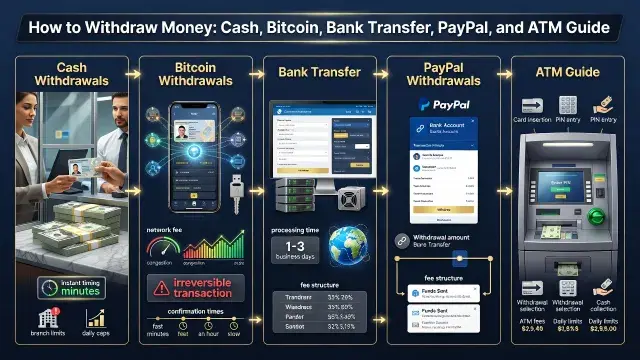
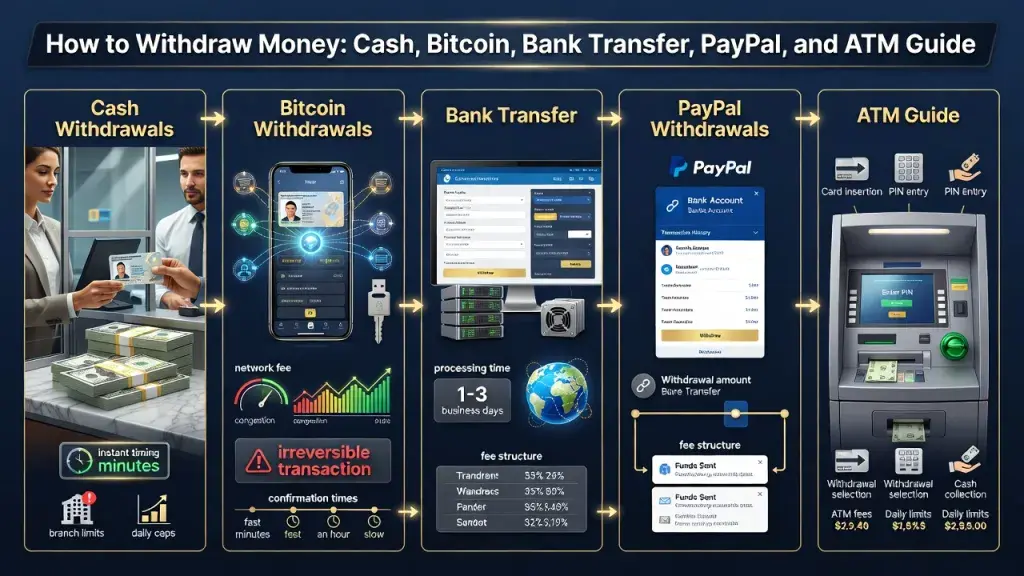
The right choice depends on three factors: how fast you need the money, how much you're moving, and what fees you're willing to accept. Someone withdrawing a small amount for daily expenses will prioritize convenience - an ATM works fine. Someone withdrawing a large sum internationally will care more about fees and security than speed. Below is a general comparison to keep in mind before diving into each method individually.
- Cash withdrawals: instant but limited by location and daily caps
- Bitcoin withdrawals: fast but variable in cost depending on network congestion
- Bank transfers: reliable but slower, especially across borders
- PayPal withdrawals: convenient for digital-first users, moderate speed
- ATM withdrawals: universally accessible but capped by daily limits
How to Withdraw in Cash
Cash remains the most tangible and immediate form of money, and despite the rise of digital payments, it hasn't lost relevance. Knowing how to withdraw in cash properly - whether from a bank teller, a payment platform, or a cash-out service - avoids unnecessary fees and delays.
Withdrawing Cash from a Bank Branch
Walking into a branch remains the most straightforward method for large cash withdrawals. Tellers can process amounts beyond typical ATM limits, though very large withdrawals sometimes require advance notice so the branch can have enough physical currency on hand. Identification is mandatory, and some banks flag unusually large withdrawals for compliance review - this isn't a sign of trouble, just standard anti-fraud procedure.
Cash-Out Services and Third-Party Locations
Retail cash-out services, check-cashing outlets, and some money transfer agents allow withdrawals without a traditional bank visit. These come with higher fees, often a flat charge plus a percentage of the amount withdrawn, but they're useful outside banking hours or in areas without nearby branches.
Limits, Fees, and Documentation to Expect
Most cash withdrawals are subject to daily or per-transaction limits set by the institution, and larger amounts may trigger additional identity verification. Expect to show government-issued ID for anything beyond routine sums, and keep in mind that some countries impose reporting thresholds on large cash transactions for regulatory reasons.
How to Withdraw in Bitcoin
Bitcoin withdrawals operate on a fundamentally different system than traditional banking - no central authority approves the transaction, and confirmation depends on the blockchain network itself rather than a bank's internal processing schedule.
Setting Up a Wallet Before You Withdraw
Before initiating any bitcoin withdrawal, you need a wallet address to receive the funds. This can be a software wallet on your phone, a hardware wallet for cold storage, or an address provided by an exchange. Double-checking the address before confirming a withdrawal matters enormously - blockchain transactions are irreversible, and sending funds to the wrong address means permanent loss.
Network Fees and Confirmation Times
Unlike bank transfers, bitcoin withdrawal fees fluctuate based on network congestion rather than a fixed institutional rate. During periods of high demand, fees rise because miners prioritize transactions offering higher rewards. Confirmation typically takes anywhere from a few minutes to over an hour, depending on the fee paid and how busy the network is at that moment.
Security Considerations Specific to Crypto Withdrawals
Because bitcoin transactions can't be reversed or disputed the way card payments can, security checks before withdrawal matter more than with almost any other method. Enable two-factor authentication on any platform holding your bitcoin, verify withdrawal addresses character by character, and be wary of platforms that promise unusually fast processing with no fee - that's often a red flag rather than a convenience.
How to Withdraw in Bank Transfer
Bank transfers remain the backbone of formal financial movement, trusted for their traceability and regulatory oversight, even if they lack the instant gratification of cash or the borderless nature of crypto.
Domestic vs. International Transfers
Domestic bank transfers, especially within the same national banking network, often clear within a single business day and sometimes instantly if both banks participate in a real-time settlement system. International transfers involve currency conversion and intermediary banks, which stretches processing time to several business days and introduces additional fees at each stage the money passes through.
Processing Times and What Causes Delays
Delays typically stem from three sources: weekend and holiday processing gaps, manual compliance checks on larger amounts, and incorrect account details submitted at the start. Double-checking routing numbers, account numbers, and recipient names before submitting a transfer prevents the most common hold-ups.
Fees Associated with Bank Withdrawals
Fees vary depending on whether the transfer is domestic or international, and whether it's processed as a standard or expedited transfer. Many banks now offer free domestic transfers between accounts held at the same institution, while cross-border transfers almost always carry a fixed fee plus a currency conversion markup.
How to Withdraw in PayPal
PayPal sits at an interesting intersection between traditional banking and digital-first convenience, offering multiple withdrawal paths depending on how quickly you need the funds and what you're willing to pay for speed.
Linking a Bank Account or Card for Withdrawals
The most common way to withdraw involves linking a bank account or debit card directly to your PayPal balance. Once linked and verified, funds can be transferred out, with standard transfers typically arriving within one to three business days at no additional cost.
Standard vs. Instant Transfer Options
PayPal offers an instant transfer option for users who need funds immediately, usually depositing money within minutes rather than days. This convenience comes at a cost - a small percentage fee deducted from the withdrawal amount - making it worthwhile only when speed genuinely matters more than the fee.
Common Issues When Withdrawing from PayPal
Withdrawal holds sometimes occur on new accounts, accounts with limited transaction history, or after unusual activity triggers automated review. Verifying your identity fully and linking a confirmed bank account in advance reduces the likelihood of delays when you actually need to move money out.
How to Withdraw in ATM
ATMs remain the most globally accessible withdrawal method, present in nearly every city worldwide and operating independently of business hours or teller availability.
Using Your Own Bank's ATM Network
Withdrawing from an ATM within your own bank's network is typically free and instant, with funds deducted immediately from your account balance. Daily withdrawal limits apply, usually set by your bank based on your account type and history, and can often be adjusted temporarily by contacting customer service if you need a larger amount.
Withdrawing Cash Abroad or from Other Banks
Using an out-of-network or foreign ATM typically triggers two fees: one from your own bank and one from the ATM operator. Currency conversion rates applied at foreign ATMs also tend to be less favorable than those offered through direct bank transfers, so for large international cash needs, it's often cheaper to withdraw in bulk less frequently rather than making several small withdrawals.
ATM Withdrawal Limits and Safety Tips
Daily limits exist primarily as a fraud-prevention measure, protecting account holders in case a card is stolen or compromised. When withdrawing cash from an ATM, especially in unfamiliar locations, checking for card skimming devices and covering the keypad while entering your PIN are simple habits that meaningfully reduce fraud risk.
Frequently Asked Questions
Which withdrawal method is cheapest overall?
Domestic bank transfers and ATM withdrawals within your own bank's network are typically free or very low cost. Bitcoin and PayPal instant transfers tend to carry the highest variable fees, especially during network congestion or when speed is prioritized.
Why did my bank flag my cash withdrawal?
Banks monitor large or unusual cash withdrawals as part of standard anti-fraud and regulatory compliance procedures. This doesn't mean anything is wrong - it simply means the transaction crossed a threshold requiring manual verification, which usually resolves within the same day.
Can I reverse a bitcoin withdrawal if I make a mistake?
No. Blockchain transactions are permanent once confirmed, so sending funds to the wrong address or network results in irreversible loss in almost all cases. Always verify the wallet address and network type carefully before confirming.
Is PayPal's instant transfer worth the fee?
It depends on how urgently you need the funds. If waiting one to three business days isn't a problem, the standard free transfer makes more sense; if you need cash within minutes, the small percentage fee is a reasonable trade-off.
Why do foreign ATM withdrawals cost more than expected?
Foreign ATM withdrawals often involve two separate fees - one from your bank and one from the local ATM operator - plus a less favorable currency conversion rate than you'd get through a direct bank transfer. Withdrawing larger amounts less frequently usually minimizes the overall cost.
What's the fastest way to get cash in an emergency?
An ATM withdrawal is almost always the fastest option since funds are available instantly, assuming you haven't hit your daily limit. A visit to a bank branch is the next fastest route for larger amounts that exceed standard ATM caps.