Most product demos fail before the presenter says a single word. The failure happens earlier, in a planning meeting where nobody wrote down what the demo was actually supposed to accomplish. A demo without a defined objective is just a guided tour, and guided tours rarely close deals or win stakeholder buy-in. The presenter clicks through features, the audience nods politely, and everyone leaves with a vague sense that something was shown but nothing was decided.
This is where goal setting stops being a corporate buzzword and becomes a functional tool. When a team treats a demo presentation the way an athlete treats a training block - with a specific, measurable target - the entire structure of the presentation changes. Some teams even sharpen this discipline by rehearsing against a live scenario, such as the goal demo built for exactly this kind of practice, where the pressure of a real-time audience forces presenters to commit to a single objective instead of hedging with a feature dump. That kind of rehearsal exposes weak objectives fast, because a vague goal collapses the moment someone asks a pointed question.
What follows is a practical breakdown of how goal setting and demo objectives interact, why most demo presentations lose their audience within the first five minutes, and how disciplined planning turns a routine product demo into a repeatable engine for goal achievement.
Understanding the Link Between Goal Setting and Demo Success
Why Most Demos Lack a Real Objective
Ask ten presenters why they're running a particular product demo, and most will say something like "to show the client what we built." That's not an objective - it's a description of an activity. A real objective specifies the decision or action the audience should take afterward: approve a budget, sign a pilot agreement, escalate to a technical evaluation. Without that specificity, the presenter has no way to judge whether the session succeeded, and the audience has no reason to act.
How Goal Setting Shapes the Presenter's Choices
Once a clear objective exists, every decision in the demo becomes easier. Which features to show, how much time to spend on each, which questions to anticipate - all of it flows from the goal. A presenter aiming to secure technical validation from an engineering team will structure the session completely differently than one aiming to win emotional buy-in from a marketing director. Goal setting acts as a filter that removes irrelevant content before it ever reaches the audience.
The Cost of Skipping This Step
Teams that skip explicit goal setting tend to over-prepare on features and under-prepare on persuasion. They walk into the room ready to answer "what does this do" but not "why should I care right now." The result is a technically competent demo presentation that still fails to move the buyer forward, because competence was never the actual barrier to the sale.
Defining Clear Demo Objectives Before You Build the Presentation
The Difference Between an Objective and a Talking Point
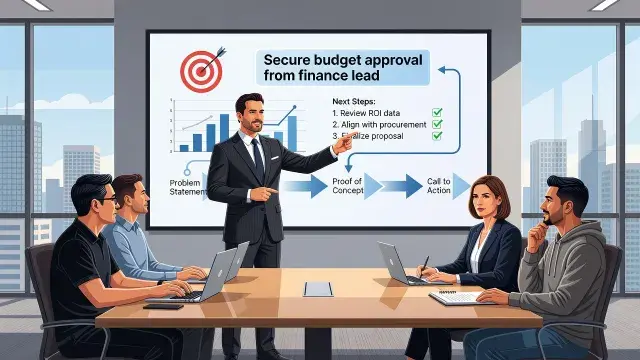
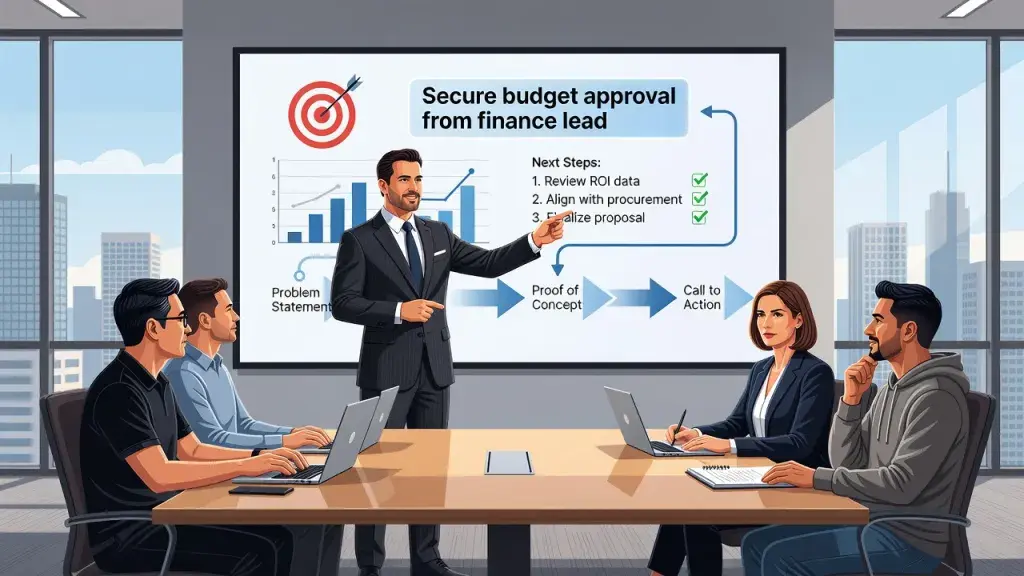
A talking point describes a feature. A demo objective describes an outcome. "Show the reporting dashboard" is a talking point. "Convince the finance lead that the reporting dashboard eliminates their monthly reconciliation problem" is an objective. The second version tells the presenter exactly what evidence to gather and what reaction to look for.
Writing Objectives That Are Specific and Testable
Strong demo objectives share three traits: they name a specific audience member or role, they name a specific behavior change, and they can be verified during or immediately after the session. If an objective can't be confirmed by watching the room, it's too abstract to guide the presentation.
Aligning Objectives With the Buyer's Stage in the Process
An early-stage prospect needs a different objective than a prospect three weeks from a contract decision. Early on, the objective might be building trust in the product's core premise. Later, it might be neutralizing a specific technical objection. Matching the objective to the stage prevents presenters from over-selling too early or under-selling too late.
- Discovery stage: establish credibility and relevance
- Evaluation stage: prove a specific capability under real conditions
- Decision stage: remove the final objection standing between interest and commitment
Structuring a Product Demo Around a Single Core Goal
Why One Objective Beats Five
Presenters often try to accomplish too much in one session - showcase every feature, address every persona, answer every hypothetical question. This dilutes attention and buries the one message that actually matters. A product demo built around a single core goal is sharper, shorter, and easier for the audience to remember afterward.
Sequencing Content to Support the Goal
Once the core goal is fixed, content should be sequenced like an argument: establish the problem, show the specific capability that solves it, then provide proof that the solution holds up under real conditions. Anything that doesn't serve this sequence should be cut or moved to a follow-up conversation.
Handling Multiple Stakeholders Without Losing Focus
When a demo audience includes several roles - a technical lead, a budget owner, an end user - the temptation is to split attention evenly. Instead, keep the primary objective anchored to the person with the most influence over the decision, while briefly acknowledging the others' concerns without letting the session drift.
Delivering a Demo Presentation That Reinforces the Objective
Opening the Session With the Objective in Mind
The first two minutes of a demo presentation set the frame for everything after. Presenters who state, directly or indirectly, what the session will help the audience decide, create a mental checklist the audience unconsciously uses to evaluate everything that follows.
Reading the Room and Adjusting in Real Time
Objectives set the plan, but a demo presentation is a live event. If the audience's questions reveal that the actual blocking concern is different from what was anticipated, a skilled presenter adjusts the sequence without abandoning the underlying goal. Rigid adherence to a script, even a well-designed one, can undermine the very objective it was meant to serve.
Closing With a Clear Next Step
A demo presentation that ends without a concrete next action wastes the momentum it built. The closing should tie directly back to the original objective - if the goal was technical validation, the next step is a scoping call; if the goal was budget approval, the next step is a formal proposal.
Measuring Goal Achievement After the Demo Ends
Defining What Success Actually Looks Like
Goal achievement should be measured against the objective set before the session, not against how smoothly the presentation went. A technically flawless demo that fails to produce the intended decision is a failure by the only standard that matters.
Common Signals That Indicate the Objective Was Met
Concrete signals include the stakeholder explicitly agreeing to a next step, a change in the tone or specificity of their questions, or a request for follow-up materials tied directly to the demo's core claim. Vague positive feedback ("that was interesting") is not a reliable signal.
Using Post-Demo Data to Refine Future Objectives
Every demo generates information about which objectives resonated and which fell flat. Teams that review this consistently - what was asked, what caused hesitation, what triggered enthusiasm - build sharper demo objectives over time, turning each session into training data for the next one.
Building a Repeatable System for Demo Objectives Across a Team
Standardizing How Objectives Are Documented
Individual presenters develop instincts over time, but instincts don't scale across a team. Writing down the objective, the target stakeholder, and the intended next step before every demo creates consistency and makes coaching possible.
Training New Presenters on Goal Setting, Not Just Product Knowledge
New team members are usually trained heavily on product features and lightly, if at all, on how to set an objective for a session. This imbalance produces presenters who know the product cold but still struggle to move a conversation forward.
Reviewing and Adjusting the System Over Time
A demo framework that worked a year ago may not fit today's buyer behavior or product maturity. Periodic review of objective-setting practices, not just win rates, keeps the whole system aligned with how the product actually gets adopted.
Frequently Asked Questions
How specific should a demo objective be before I start building the presentation?
It should name the exact person or role you're trying to move, the specific belief or objection you're addressing, and the action you want them to take next. If you can't state all three in one sentence, the objective needs more work before you start building slides or scripts.
Can a single demo have more than one objective?
It's possible, but risky. Multiple objectives usually mean multiple audiences, and trying to satisfy all of them in one session tends to weaken the persuasive power of each individual point. It's often better to run a shorter, more targeted session and follow up separately with secondary stakeholders.
What's the biggest mistake teams make when setting demo objectives?
Confusing an activity with an outcome. "Demonstrate the integration feature" is an activity. "Convince the IT lead the integration won't require additional headcount" is an outcome. Teams that only plan activities end up with demos that feel complete but don't move the deal forward.
How do I know if my demo presentation actually achieved its goal?
Look for concrete behavioral signals, not politeness. A stakeholder agreeing to a specific next step, asking sharper technical questions, or requesting a follow-up tied to your core claim are all strong indicators. General praise without a next action usually means the objective wasn't fully met.
Should the objective change based on who's in the room?
Yes. A demo aimed at a technical evaluator should prioritize proof and depth, while one aimed at a budget owner should prioritize business impact and risk reduction. Keep the core product story consistent, but adjust the specific objective and supporting evidence to match the primary decision-maker present.
How often should a team revisit its approach to demo objectives?
A quarterly review works well for most teams, especially when paired with feedback from recent sessions. Product changes, shifts in buyer priorities, and lessons from won or lost deals all affect what a good objective looks like, so treating the framework as fixed for years at a time usually leads to stale, less effective demos.